src/driver/ixgbe.c
The ixgbe driver: bring-up plus the RX/TX batch hot paths.
Walkthrough, interview notes & deep dive
The driver/ixgbe.c file is the heart of the ixy driver, providing the low-level implementation for the Intel 82599 family of 10GbE NICs. For an engineer focusing on high-performance dataplanes, understanding this file is critical because it demonstrates how to bypass the kernel and manage hardware directly from userspace. The implementation follows a strict "poll-mode" architecture where the driver is responsible for every aspect of device state, from initial PCI mapping to the high-speed processing of descriptor rings.
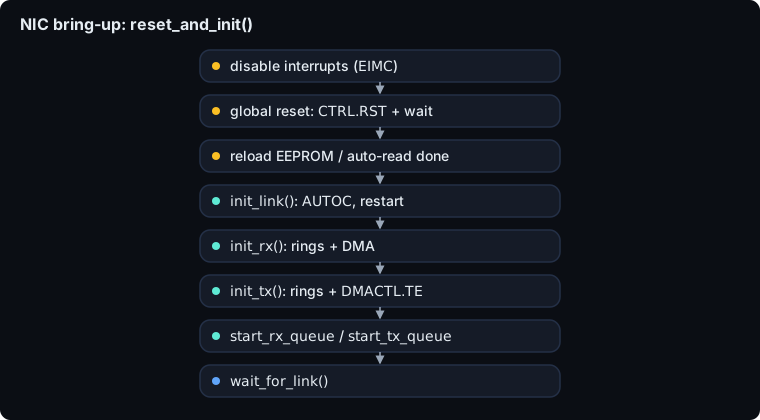
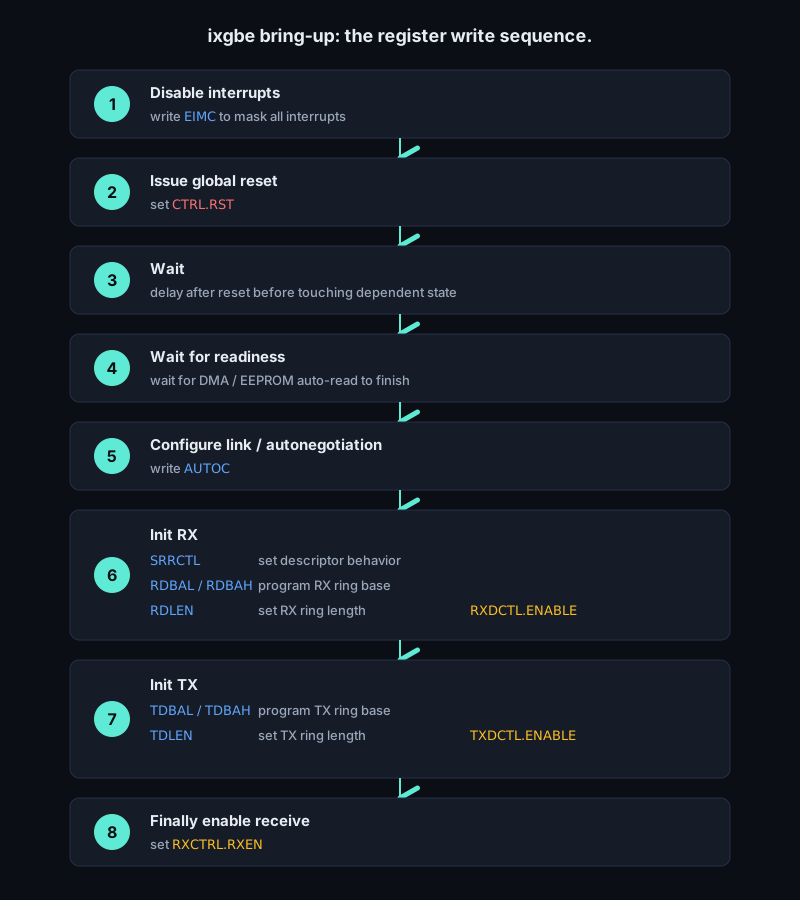
Device initialization and bring-up begins with ixgbe_init, which sets up the memory-mapped I/O (MMIO) and handles the transition between standard PCI resources and VFIO for IOMMU-protected access. The actual hardware state machine is managed in reset_and_init. This function follows the Intel datasheet sequence: disabling interrupts, triggering a global software reset via the IXGBE_CTRL register, and waiting for the hardware to signal readiness.
// section 4.6.3.1 - disable all interrupts
disable_interrupts(dev);
// section 4.6.3.2
set_reg32(dev->addr, IXGBE_CTRL, IXGBE_CTRL_RST_MASK);
wait_clear_reg32(dev->addr, IXGBE_CTRL, IXGBE_CTRL_RST_MASK);
usleep(10000);
After the reset, the driver must wait for the EEPROM auto-read to complete (IXGBE_EEC_ARD) and for the DMA engine to initialize (IXGBE_RDRXCTL_DMAIDONE). The link negotiation is then triggered in init_link, which sets the IXGBE_AUTOC register for 10G serial communication. The driver polls the IXGBE_LINKS register in wait_for_link to ensure the physical layer is up before enabling the receive and transmit paths.
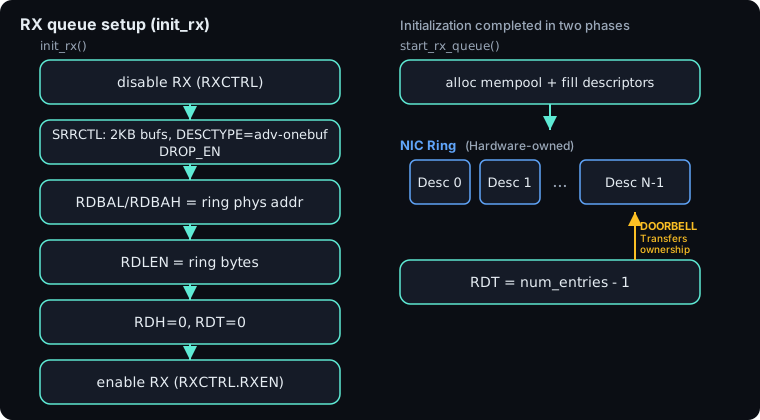
RX queue initialization is performed in init_rx and start_rx_queue. The core of the receive path is the descriptor ring, a circular buffer of 16-byte descriptors shared between the CPU and the NIC. The driver allocates DMA-capable memory for these descriptors and tells the hardware the physical address using the IXGBE_RDBAL (Receive Descriptor Base Address Low) and IXGBE_RDBAH registers.
The driver also initializes a mempool of pkt_buf structures. Each descriptor in the ring is pre-filled with the physical address of a buffer's data area. This allows the NIC to perform zero-copy DMA directly into userspace memory as packets arrive. Crucially, the driver sets the IXGBE_SRRCTL_DROP_EN flag; this ensures that if the CPU cannot keep up with the packet rate, the NIC drops packets at the wire rather than allowing an overflowing queue to stall the entire internal switch fabric of the NIC.
for (int i = 0; i < queue->num_entries; i++) {
	volatile union ixgbe_adv_rx_desc* rxd = queue->descriptors + i;
	struct pkt_buf* buf = pkt_buf_alloc(queue->mempool);
	if (!buf) {
		error("failed to allocate rx descriptor");
	}
	rxd->read.pkt_addr = buf->buf_addr_phy + offsetof(struct pkt_buf, data);
	rxd->read.hdr_addr = 0;
	queue->virtual_addresses[i] = buf;
}
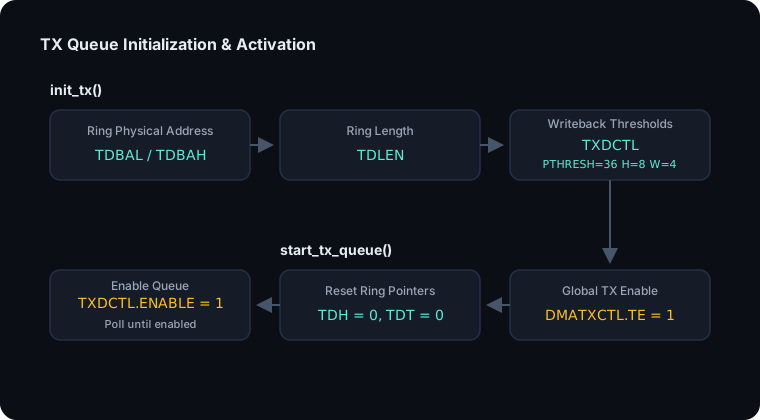
TX queue initialization mirrors the RX path but focuses on performance tuning for transmission. In init_tx, the driver sets up the IXGBE_TDBAL and IXGBE_TDLEN registers to define the ring. A key optimization point is the IXGBE_TXDCTL register, which controls the prefetch and write-back thresholds (pthresh, hthresh, and wthresh). These values determine how many descriptors the NIC fetches in a single PCIe burst and when it writes back the status bits to host memory. ixy uses defaults derived from DPDK to balance latency and PCIe efficiency.
uint32_t txdctl = get_reg32(dev->addr, IXGBE_TXDCTL(i));
// pthresh: 6:0, hthresh: 14:8, wthresh: 22:16
txdctl &= ~(0x7F | (0x7F << 8) | (0x7F << 16));
txdctl |= (36 | (8 << 8) | (4 << 16)); // from DPDK
set_reg32(dev->addr, IXGBE_TXDCTL(i), txdctl);
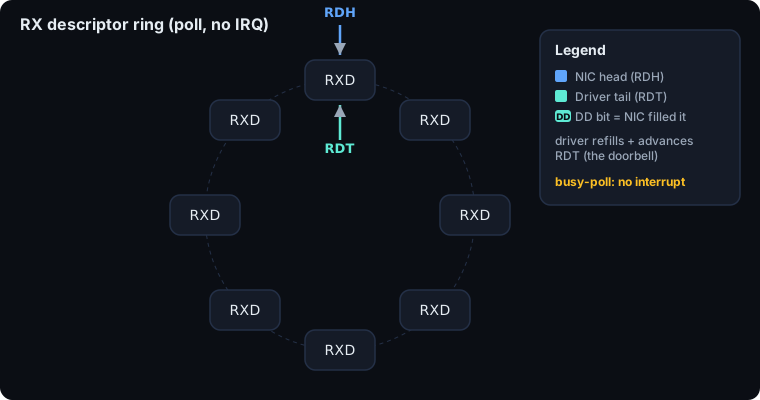
The RX hot path implemented in ixgbe_rx_batch is a high-speed loop that processes the descriptor ring. The driver maintains a local rx_index and checks the IXGBE_RXDADV_STAT_DD (Descriptor Done) bit in the descriptor's status field. If DD is set, the hardware has finished writing a packet to the buffer. The driver then performs a "buffer swap": it takes the pkt_buf containing the packet to hand it to the application and immediately allocates a new pkt_buf from the mempool to refill the descriptor.
To signal the hardware that new descriptors are available for use, the driver updates the IXGBE_RDT (Receive Descriptor Tail) register. This update is a "doorbell" write that informs the NIC it can resume DMA operations up to the new tail index.
volatile union ixgbe_adv_rx_desc* desc_ptr = queue->descriptors + rx_index;
uint32_t status = desc_ptr->wb.upper.status_error;
if (status & IXGBE_RXDADV_STAT_DD) {
	struct pkt_buf* buf = (struct pkt_buf*) queue->virtual_addresses[rx_index];
	buf->size = desc.wb.upper.length;
	struct pkt_buf* new_buf = pkt_buf_alloc(queue->mempool);
	desc_ptr->read.pkt_addr = new_buf->buf_addr_phy + offsetof(struct pkt_buf, data);
	desc_ptr->read.hdr_addr = 0;
	queue->virtual_addresses[rx_index] = new_buf;
	bufs[buf_index] = buf;
}
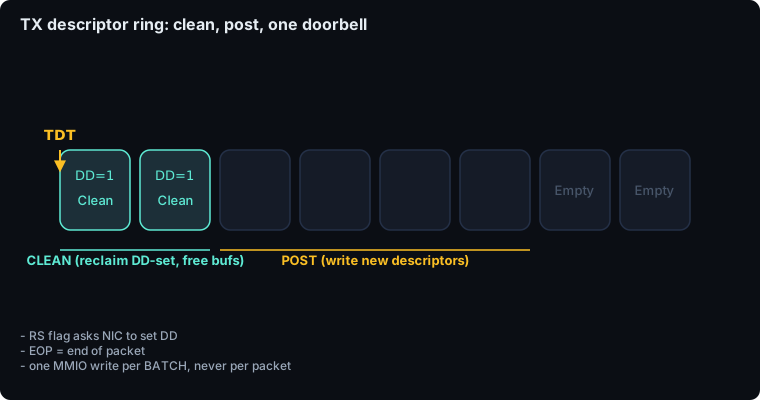
The TX hot path in ixgbe_tx_batch handles both the cleanup of sent packets and the submission of new ones. Cleaning is done in batches (TX_CLEAN_BATCH) to reduce the frequency of status checks. The driver checks the DD bit of a descriptor ahead in the ring; if set, it implies all previous packets in that batch are also sent, and their buffers can be freed back to the mempool.
For transmission, the driver fills descriptors with the physical addresses of the user-provided bufs. It sets the IXGBE_ADVTXD_DCMD_RS (Report Status) bit on descriptors to request the hardware to write back the DD bit once finished. Finally, it updates the IXGBE_TDT (Transmit Descriptor Tail) register to notify the NIC of the new work.
txd->read.buffer_addr = buf->buf_addr_phy + offsetof(struct pkt_buf, data);
txd->read.cmd_type_len = IXGBE_ADVTXD_DCMD_EOP | IXGBE_ADVTXD_DCMD_RS |
                         IXGBE_ADVTXD_DCMD_IFCS | IXGBE_ADVTXD_DCMD_DEXT |
                         IXGBE_ADVTXD_DTYP_DATA | buf->size;
txd->read.olinfo_status = buf->size << IXGBE_ADVTXD_PAYLEN_SHIFT;
set_reg32(dev->addr, IXGBE_TDT(queue_id), queue->tx_index);
Interview angles
- Why batch packets in the RX and TX functions?
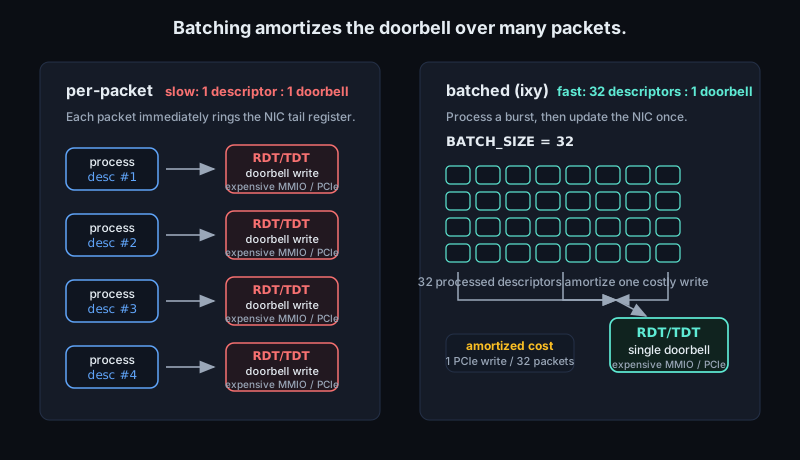
Batching reduces the overhead of "doorbell" writes to PCI registers (like IXGBE_TDT). Each MMIO write is expensive because it involves the PCIe bus and forces synchronization between the CPU and the NIC. Batching also improves cache locality and allows for better pipelining of descriptor processing.
- How does the NIC signal that a descriptor is finished?
The NIC uses the DD (Descriptor Done) bit in the write-back format of the descriptor. For RX, this is set when a packet is written to memory. For TX, it is set after the NIC has read the data and transmitted it over the wire, provided the RS (Report Status) bit was set by the driver in the command field.
- What is the significance of the RDT and TDT registers?
These are "Tail" registers. In the circular ring model, the CPU "owns" the descriptors between the Head and Tail. By writing to RDT or TDT, the CPU effectively hands over ownership of a set of descriptors to the NIC hardware, signaling that they are ready for reception or transmission.
- How is zero-copy achieved in this driver?
Zero-copy is achieved by using a shared memory mempool. The driver allocates DMA-compatible memory for packet buffers at startup. During RX, the NIC DMAs data directly into these buffers. The driver simply passes a pointer to this buffer to the application. There is no memcpy between kernel and userspace because the driver operates entirely in userspace.
Going deeper
#define wrap_ring(index, ring_size) (uint16_t) ((index + 1) & (ring_size - 1))
The driver enforces that queue->num_entries is a power of two to replace the expensive modulo operator with a bitwise AND. In the high-speed datapath, a DIV instruction can take dozens of cycles, whereas & (ring_size - 1) is a single-cycle operation. This requires a strict check during initialization using queue->num_entries & (queue->num_entries - 1) to ensure only one bit is set in the entry count.
set_reg32(dev->addr, IXGBE_RDT(queue_id), last_rx_index);
// this is intentionally off by one, otherwise we'd set RDT=RDH if we are receiving faster than packets are coming in
// RDT=RDH means queue is full
The Intel 82599 hardware uses a "Head" (RDH) and "Tail" (RDT) pointer to manage the ring. If the CPU sets RDT equal to RDH, the hardware logic interprets this as the ring being empty (no descriptors available for the NIC to fill). By updating RDT to last_rx_index (the descriptor just processed) rather than rx_index (the next one to check), the driver ensures the NIC always sees at least one descriptor as "unavailable," preventing the ambiguous "full vs empty" state that would stall the DMA engine.
int32_t cleanup_to = clean_index + TX_CLEAN_BATCH - 1;
if (cleanup_to >= queue->num_entries) {
    cleanup_to -= queue->num_entries;
}
volatile union ixgbe_adv_tx_desc* txd = queue->descriptors + cleanup_to;
uint32_t status = txd->wb.status;
if (status & IXGBE_ADVTXD_STAT_DD) {
The TX cleanup logic uses a batching optimization where it only checks the Descriptor Done (DD) bit of the *last* descriptor in a TX_CLEAN_BATCH (32 descriptors). Since the hardware processes descriptors strictly in order, if the 32nd descriptor is marked as sent, the driver can safely assume the previous 31 are also finished. This significantly reduces non-posted PCIe reads and cache line bouncing on the descriptor ring, which are major bottlenecks in 10GbE transmission.
set_reg32(dev->addr, IXGBE_TDT(queue_id), queue->tx_index);
The final write to the Transmit Descriptor Tail (TDT) register acts as a doorbell, notifying the NIC that new packets are ready. The driver notes that x86 Total Store Ordering (TSO) prevents writes from being reordered, meaning the descriptor data reaches RAM before the MMIO write triggers the NIC fetch. On weakly-ordered architectures like ARM or PowerPC, this line would require an explicit dmb (Data Memory Barrier) to prevent the NIC from reading "stale" descriptor memory before the CPU's writes to the ring are globally visible.
Harder interview questions
- What is the purpose of
IXGBE_SRRCTL_DROP_ENin the RX configuration? — It prevents head-of-line blocking by telling the NIC to drop packets for a specific queue if its descriptor ring is full, rather than letting that one queue fill up the entire shared on-chip packet buffer and stalling other queues.
- Why does the driver
memsetthe DMA memory to-1(0xFF) before activation? — This is the "Snabb trick" to prevent rogue DMA; if the hardware prematurely fetches a descriptor before the driver has initialized it, an address of all-ones (0xFFFFFFFFFFFFFFFF) is more likely to trigger an IOMMU fault or a recognizable error than a zeroed address which might point to valid physical memory.
- Why is the
RS(Report Status) bit set in every TX descriptor instead of just the last one? — While checking only every 32nd descriptor is efficient for the CPU, settingRSon every descriptor (viaIXGBE_ADVTXD_DCMD_RS) ensures the NIC writes back status bits frequently, providing finer-grained telemetry for theclean_indexlogic and avoiding "long tail" latency in buffer reclamation.
- How does the driver handle multi-segment packets? — It doesn't; the code explicitly checks
IXGBE_RXDADV_STAT_EOP(End of Packet) and throws an error if a packet spans multiple descriptors, requiring the user to either increase the buffer size (currently fixed at 2048 bytes) or decrease the MTU.
- What are the implications of using
volatileon the descriptor pointers? — It prevents the compiler from caching descriptor values in registers; every check of theDDbit must result in a fresh load from memory, which is essential because the hardware modifies the descriptors asynchronously via DMA.
Gotchas
- The
wrap_ringmacro will fail silently ifnum_entriesis not a power of two, leading to memory corruption or infinite loops. - Updating
RDTtoo frequently (e.g., after every single packet) can saturate the PCIe bus with small MMIO writes; batching the tail update is critical for 10G performance. - The
virtual_addressesarray is a parallel metadata structure; if it gets out of sync with the physicaldescriptorsring,pkt_buf_freewill release the wrong memory, causing nearly impossible-to-debug heap corruption. - Failing to read the
EICRregister after an interrupt is signaled via VFIO will prevent the NIC from asserting future interrupts, effectively "hanging" the datapath in interrupt mode.
From ixy to a production driver
The production shape: Linux ixgbe.ko and DPDK's net_ixgbe PMD solve the same hardware problem as this file: reset an Intel 82599, program queues, hand buffers to DMA, reclaim descriptors, track link, and expose policy upward. ixy is intentionally a teaching driver: one NIC, one RX/TX queue pair, one memory model, and one fast path. Production drivers must survive sharing, configuration, errors, virtualization, observability, and mixed workloads.
Interrupts and polling: ixy's normal path is pure polling: ixgbe_rx_batch() spins on the descriptor DD bit and writes IXGBE_RDT; TX cleanup is batched before IXGBE_TDT. Linux instead wires each queue vector to a struct napi_struct; an IRQ schedules ixgbe_poll(), then NAPI drains RX/TX work under a budget and re-enables interrupts when the ring is quiet. That avoids interrupt storms under load without burning a full core when idle. The 82599 EITR/ITR registers become latency-throughput policy. ixy can program VFIO MSI/MSI-X, EICR, and EIMS, but the central model remains "the application polls."
Scaling out: a real 82599 can expose 128 RX and 128 TX queues and SR-IOV resources for up to 64 pools/VFs. Linux and DPDK configure RSS through IXGBE_MRQC and IXGBE_RETA, then bind rings to CPUs, NAPI instances, MSI-X vectors, or PMD threads. They also need per-queue synchronization and netdev/ethdev configuration paths. ixy avoids that: one queue means no RSS indirection table, no cross-core queue ownership question, and no queue locking.
Packet features: production TX handles checksum offload and TSO using advanced descriptors, context descriptors, and bits such as IXGBE_ADVTXD_DCMD_TSE; Linux receives SKBs from ndo_start_xmit(), while DPDK consumes rte_mbuf offload flags via rte_eth_tx_burst(). Production RX reports checksum status, packet type, VLANs, and may enable LRO/RSC policy. ixy leaves those descriptor fields clear and comments where offloads would go.
Large packets and failure modes: ixy uses one-buffer advanced RX descriptors and treats !EOP as an error, so jumbo frames and scatter-gather chains are outside the lesson. Linux and DPDK handle multi-segment packets, MTU changes, and ring refill edge cases. They also expose ethtool stats, including the 82599's reset-on-read statistics block, link diagnostics, MAC/PHY errors, link flap handling, watchdog resets, PCI D-states, hotplug/remove, and SR-IOV PF/VF control. ixy's IXGBE_SRRCTL_DROP_EN, single 128KB RX packet buffer, and minimal reset path are the trade: less production behavior, but a clearer view of descriptors, DMA, MMIO doorbells, and polling.
Sources
Source
#include <stdlib.h>
#include <string.h>
#include <unistd.h>
#include <linux/limits.h>
#include <linux/vfio.h>
#include <sys/stat.h>

#include "log.h"
#include "ixgbe.h"
#include "pci.h"
#include "memory.h"
#include "driver/ixgbe_type.h"
#include "driver/device.h"

#include "libixy-vfio.h"
#include "interrupts.h"
#include "stats.h"

const char* driver_name = "ixy-ixgbe";

const int MAX_RX_QUEUE_ENTRIES = 4096;
const int MAX_TX_QUEUE_ENTRIES = 4096;

const int NUM_RX_QUEUE_ENTRIES = 512;
const int NUM_TX_QUEUE_ENTRIES = 512;

const int PKT_BUF_ENTRY_SIZE = 2048;
const int MIN_MEMPOOL_ENTRIES = 4096;

const int TX_CLEAN_BATCH = 32;

const uint64_t INTERRUPT_INITIAL_INTERVAL = 1000 * 1000 * 1000;

// allocated for each rx queue, keeps state for the receive function
struct ixgbe_rx_queue {
	volatile union ixgbe_adv_rx_desc* descriptors;
	struct mempool* mempool;
	uint16_t num_entries;
	// position we are reading from
	uint16_t rx_index;
	// virtual addresses to map descriptors back to their mbuf for freeing
	void* virtual_addresses[];
};

// allocated for each tx queue, keeps state for the transmit function
struct ixgbe_tx_queue {
	volatile union ixgbe_adv_tx_desc* descriptors;
	uint16_t num_entries;
	// position to clean up descriptors that where sent out by the nic
	uint16_t clean_index;
	// position to insert packets for transmission
	uint16_t tx_index;
	// virtual addresses to map descriptors back to their mbuf for freeing
	void* virtual_addresses[];
};

/**
 * Set the IVAR registers, mapping interrupt causes to vectors
 * @param dev pointer to device
 * @param direction 0 for Rx, 1 for Tx
 * @param queue queue to map the corresponding interrupt to
 * @param msix_vector the vector to map to the corresponding queue
 */
static void set_ivar(struct ixgbe_device* dev, int8_t direction, int8_t queue, int8_t msix_vector) {
	u32 ivar, index;
	msix_vector |= IXGBE_IVAR_ALLOC_VAL;
	index = ((16 * (queue & 1)) + (8 * direction));
	ivar = get_reg32(dev->addr, IXGBE_IVAR(queue >> 1));
	ivar &= ~(0xFF << index);
	ivar |= (msix_vector << index);
	set_reg32(dev->addr, IXGBE_IVAR(queue >> 1), ivar);
}

/**
 * Clear all interrupt masks for all queues.
 * @param dev The device.
 */
static void clear_interrupts(struct ixgbe_device* dev) {
	// Clear interrupt mask
	set_reg32(dev->addr, IXGBE_EIMC, IXGBE_IRQ_CLEAR_MASK);
	get_reg32(dev->addr, IXGBE_EICR);
}

/**
 * Clear interrupt for queue.
 * @param dev The device.
 * @param queue_id The ID of the queue to clear.
 */
static void clear_interrupt(struct ixgbe_device* dev, uint16_t queue_id) {
	// Clear interrupt mask
	set_reg32(dev->addr, IXGBE_EIMC, 1 << queue_id);
	get_reg32(dev->addr, IXGBE_EICR);
}

/**
 * Disable all interrupts for all queues.
 * @param dev The device.
 */
static void disable_interrupts(struct ixgbe_device* dev) {
	// Clear interrupt mask to stop from interrupts being generated
	set_reg32(dev->addr, IXGBE_EIMS, 0x00000000);
	clear_interrupts(dev);
}

/**
 * Disable interrupt for queue
 * @param dev
 * @param queue_id The ID of the queue to disable.
 */
static void disable_interrupt(struct ixgbe_device* dev, uint16_t queue_id) {
	// Clear interrupt mask to stop from interrupts being generated
	u32 mask = get_reg32(dev->addr, IXGBE_EIMS);
	mask &= ~(1 << queue_id);
	set_reg32(dev->addr, IXGBE_EIMS, mask);
	clear_interrupt(dev, queue_id);
	debug("Using polling");
}

/**
 * Enable MSI interrupt for queue.
 * @param dev The device.
 * @param queue_id The ID of the queue to enable.
 */
static void enable_msi_interrupt(struct ixgbe_device* dev, uint16_t queue_id) {
	// Step 1: The software driver associates between Tx and Rx interrupt causes and the EICR
	// register by setting the IVAR[n] registers.
	set_ivar(dev, 0, queue_id, 0);

	// Step 2: Program SRRCTL[n].RDMTS (per receive queue) if software uses the receive
	// descriptor minimum threshold interrupt
	// We don't use the minimum threshold interrupt

	// Step 3: All interrupts should be set to 0b (no auto clear in the EIAC register). Following an
	// interrupt, software might read the EICR register to check for the interrupt causes.
	set_reg32(dev->addr, IXGBE_EIAC, 0x00000000);

	// Step 4: Set the auto mask in the EIAM register according to the preferred mode of operation.
	// In our case we prefer not auto-masking the interrupts

	// Step 5: Set the interrupt throttling in EITR[n] and GPIE according to the preferred mode of operation.
	set_reg32(dev->addr, IXGBE_EITR(queue_id), dev->ixy.interrupts.itr_rate);

	// Step 6: Software clears EICR by writing all ones to clear old interrupt causes
	clear_interrupts(dev);

	// Step 7: Software enables the required interrupt causes by setting the EIMS register
	u32 mask = get_reg32(dev->addr, IXGBE_EIMS);
	mask |= (1 << queue_id);
	set_reg32(dev->addr, IXGBE_EIMS, mask);
	debug("Using MSI interrupts");
}

/**
 * Enable MSI-X interrupt for queue.
 * @param dev The device.
 * @param queue_id The ID of the queue to enable.
 */
static void enable_msix_interrupt(struct ixgbe_device* dev, uint16_t queue_id) {
	// Step 1: The software driver associates between interrupt causes and MSI-X vectors and the
	// throttling timers EITR[n] by programming the IVAR[n] and IVAR_MISC registers.
	uint32_t gpie = get_reg32(dev->addr, IXGBE_GPIE);
	gpie |= IXGBE_GPIE_MSIX_MODE | IXGBE_GPIE_PBA_SUPPORT | IXGBE_GPIE_EIAME;
	set_reg32(dev->addr, IXGBE_GPIE, gpie);
	set_ivar(dev, 0, queue_id, queue_id);

	// Step 2: Program SRRCTL[n].RDMTS (per receive queue) if software uses the receive
	// descriptor minimum threshold interrupt
	// We don't use the minimum threshold interrupt

	// Step 3: The EIAC[n] registers should be set to auto clear for transmit and receive interrupt
	// causes (for best performance). The EIAC bits that control the other and TCP timer
	// interrupt causes should be set to 0b (no auto clear).
	set_reg32(dev->addr, IXGBE_EIAC, IXGBE_EIMS_RTX_QUEUE);

	// Step 4: Set the auto mask in the EIAM register according to the preferred mode of operation.
	// In our case we prefer to not auto-mask the interrupts

	// Step 5: Set the interrupt throttling in EITR[n] and GPIE according to the preferred mode of operation.
	// 0x000 (0us) => ... INT/s
	// 0x008 (2us) => 488200 INT/s
	// 0x010 (4us) => 244000 INT/s
	// 0x028 (10us) => 97600 INT/s
	// 0x0C8 (50us) => 20000 INT/s
	// 0x190 (100us) => 9766 INT/s
	// 0x320 (200us) => 4880 INT/s
	// 0x4B0 (300us) => 3255 INT/s
	// 0x640 (400us) => 2441 INT/s
	// 0x7D0 (500us) => 2000 INT/s
	// 0x960 (600us) => 1630 INT/s
	// 0xAF0 (700us) => 1400 INT/s
	// 0xC80 (800us) => 1220 INT/s
	// 0xE10 (900us) => 1080 INT/s
	// 0xFA7 (1000us) => 980 INT/s
	// 0xFFF (1024us) => 950 INT/s
	set_reg32(dev->addr, IXGBE_EITR(queue_id), dev->ixy.interrupts.itr_rate);

	// Step 6: Software enables the required interrupt causes by setting the EIMS register
	u32 mask = get_reg32(dev->addr, IXGBE_EIMS);
	mask |= (1 << queue_id);
	set_reg32(dev->addr, IXGBE_EIMS, mask);
	debug("Using MSIX interrupts");
}

/**
 * Enable MSI or MSI-X interrupt for queue depending on which is supported (Prefer MSI-x).
 * @param dev The device.
 * @param queue_id The ID of the queue to enable.
 */
static void enable_interrupt(struct ixgbe_device* dev, uint16_t queue_id) {
	if (!dev->ixy.interrupts.interrupts_enabled) {
		return;
	}
	switch (dev->ixy.interrupts.interrupt_type) {
		case VFIO_PCI_MSIX_IRQ_INDEX:
			enable_msix_interrupt(dev, queue_id);
			break;
		case VFIO_PCI_MSI_IRQ_INDEX:
			enable_msi_interrupt(dev, queue_id);
			break;
		default:
			warn("Interrupt type not supported: %d", dev->ixy.interrupts.interrupt_type);
			return;
	}
}

/**
 * Setup interrupts by enabling VFIO interrupts.
 * @param dev The device.
 */
static void setup_interrupts(struct ixgbe_device* dev) {
	if (!dev->ixy.interrupts.interrupts_enabled) {
		return;
	}
	dev->ixy.interrupts.queues = (struct interrupt_queues*) malloc(dev->ixy.num_rx_queues * sizeof(struct interrupt_queues));
	dev->ixy.interrupts.interrupt_type = vfio_setup_interrupt(dev->ixy.vfio_fd);
	switch (dev->ixy.interrupts.interrupt_type) {
		case VFIO_PCI_MSIX_IRQ_INDEX: {
			for (uint32_t rx_queue = 0; rx_queue < dev->ixy.num_rx_queues; rx_queue++) {
				int vfio_event_fd = vfio_enable_msix(dev->ixy.vfio_fd, rx_queue);
				int vfio_epoll_fd = vfio_epoll_ctl(vfio_event_fd);
				dev->ixy.interrupts.queues[rx_queue].vfio_event_fd = vfio_event_fd;
				dev->ixy.interrupts.queues[rx_queue].vfio_epoll_fd = vfio_epoll_fd;
				dev->ixy.interrupts.queues[rx_queue].moving_avg.length = 0;
				dev->ixy.interrupts.queues[rx_queue].moving_avg.index = 0;
				dev->ixy.interrupts.queues[rx_queue].interval = INTERRUPT_INITIAL_INTERVAL;
			}
			break;
		}
		case VFIO_PCI_MSI_IRQ_INDEX: {
			int vfio_event_fd = vfio_enable_msi(dev->ixy.vfio_fd);
			int vfio_epoll_fd = vfio_epoll_ctl(vfio_event_fd);
			for (uint32_t rx_queue = 0; rx_queue < dev->ixy.num_rx_queues; rx_queue++) {
				dev->ixy.interrupts.queues[rx_queue].vfio_event_fd = vfio_event_fd;
				dev->ixy.interrupts.queues[rx_queue].vfio_epoll_fd = vfio_epoll_fd;
				dev->ixy.interrupts.queues[rx_queue].moving_avg.length = 0;
				dev->ixy.interrupts.queues[rx_queue].moving_avg.index = 0;
				dev->ixy.interrupts.queues[rx_queue].interval = INTERRUPT_INITIAL_INTERVAL;
			}
			break;
		}
		default:
			warn("Interrupt type not supported: %d", dev->ixy.interrupts.interrupt_type);
			return;
	}
}

// see section 4.6.4
static void init_link(struct ixgbe_device* dev) {
	// should already be set by the eeprom config, maybe we shouldn't override it here to support weirdo nics?
	set_reg32(dev->addr, IXGBE_AUTOC, (get_reg32(dev->addr, IXGBE_AUTOC) & ~IXGBE_AUTOC_LMS_MASK) | IXGBE_AUTOC_LMS_10G_SERIAL);
	set_reg32(dev->addr, IXGBE_AUTOC, (get_reg32(dev->addr, IXGBE_AUTOC) & ~IXGBE_AUTOC_10G_PMA_PMD_MASK) | IXGBE_AUTOC_10G_XAUI);
	// negotiate link
	set_flags32(dev->addr, IXGBE_AUTOC, IXGBE_AUTOC_AN_RESTART);
	// datasheet wants us to wait for the link here, but we can continue and wait afterwards
}

static void start_rx_queue(struct ixgbe_device* dev, int queue_id) {
	debug("starting rx queue %d", queue_id);
	struct ixgbe_rx_queue* queue = ((struct ixgbe_rx_queue*)(dev->rx_queues)) + queue_id;
	// 2048 as pktbuf size is strictly speaking incorrect:
	// we need a few headers (1 cacheline), so there's only 1984 bytes left for the device
	// but the 82599 can only handle sizes in increments of 1 kb; but this is fine since our max packet size
	// is the default MTU of 1518
	// this has to be fixed if jumbo frames are to be supported
	// mempool should be >= the number of rx and tx descriptors for a forwarding application
	int mempool_size = NUM_RX_QUEUE_ENTRIES + NUM_TX_QUEUE_ENTRIES;
	queue->mempool = memory_allocate_mempool(mempool_size < MIN_MEMPOOL_ENTRIES ? MIN_MEMPOOL_ENTRIES : mempool_size, PKT_BUF_ENTRY_SIZE);
	if (queue->num_entries & (queue->num_entries - 1)) {
		error("number of queue entries must be a power of 2");
	}
	for (int i = 0; i < queue->num_entries; i++) {
		volatile union ixgbe_adv_rx_desc* rxd = queue->descriptors + i;
		struct pkt_buf* buf = pkt_buf_alloc(queue->mempool);
		if (!buf) {
			error("failed to allocate rx descriptor");
		}
		rxd->read.pkt_addr = buf->buf_addr_phy + offsetof(struct pkt_buf, data);
		rxd->read.hdr_addr = 0;
		// we need to return the virtual address in the rx function which the descriptor doesn't know by default
		queue->virtual_addresses[i] = buf;
	}
	// enable queue and wait if necessary
	set_flags32(dev->addr, IXGBE_RXDCTL(queue_id), IXGBE_RXDCTL_ENABLE);
	wait_set_reg32(dev->addr, IXGBE_RXDCTL(queue_id), IXGBE_RXDCTL_ENABLE);
	// rx queue starts out full
	set_reg32(dev->addr, IXGBE_RDH(queue_id), 0);
	// was set to 0 before in the init function
	set_reg32(dev->addr, IXGBE_RDT(queue_id), queue->num_entries - 1);
}

static void start_tx_queue(struct ixgbe_device* dev, int queue_id) {
	debug("starting tx queue %d", queue_id);
	struct ixgbe_tx_queue* queue = ((struct ixgbe_tx_queue*)(dev->tx_queues)) + queue_id;
	if (queue->num_entries & (queue->num_entries - 1)) {
		error("number of queue entries must be a power of 2");
	}
	// tx queue starts out empty
	set_reg32(dev->addr, IXGBE_TDH(queue_id), 0);
	set_reg32(dev->addr, IXGBE_TDT(queue_id), 0);
	// enable queue and wait if necessary
	set_flags32(dev->addr, IXGBE_TXDCTL(queue_id), IXGBE_TXDCTL_ENABLE);
	wait_set_reg32(dev->addr, IXGBE_TXDCTL(queue_id), IXGBE_TXDCTL_ENABLE);
}

// see section 4.6.7
// it looks quite complicated in the data sheet, but it's actually really easy because we don't need fancy features
static void init_rx(struct ixgbe_device* dev) {
	// make sure that rx is disabled while re-configuring it
	// the datasheet also wants us to disable some crypto-offloading related rx paths (but we don't care about them)
	clear_flags32(dev->addr, IXGBE_RXCTRL, IXGBE_RXCTRL_RXEN);
	// no fancy dcb or vt, just a single 128kb packet buffer for us
	set_reg32(dev->addr, IXGBE_RXPBSIZE(0), IXGBE_RXPBSIZE_128KB);
	for (int i = 1; i < 8; i++) {
		set_reg32(dev->addr, IXGBE_RXPBSIZE(i), 0);
	}

	// always enable CRC offloading
	set_flags32(dev->addr, IXGBE_HLREG0, IXGBE_HLREG0_RXCRCSTRP);
	set_flags32(dev->addr, IXGBE_RDRXCTL, IXGBE_RDRXCTL_CRCSTRIP);

	// accept broadcast packets
	set_flags32(dev->addr, IXGBE_FCTRL, IXGBE_FCTRL_BAM);

	// per-queue config, same for all queues
	for (uint16_t i = 0; i < dev->ixy.num_rx_queues; i++) {
		debug("initializing rx queue %d", i);
		// enable advanced rx descriptors, we could also get away with legacy descriptors, but they aren't really easier
		set_reg32(dev->addr, IXGBE_SRRCTL(i), (get_reg32(dev->addr, IXGBE_SRRCTL(i)) & ~IXGBE_SRRCTL_DESCTYPE_MASK) | IXGBE_SRRCTL_DESCTYPE_ADV_ONEBUF);
		// drop_en causes the nic to drop packets if no rx descriptors are available instead of buffering them
		// a single overflowing queue can fill up the whole buffer and impact operations if not setting this flag
		set_flags32(dev->addr, IXGBE_SRRCTL(i), IXGBE_SRRCTL_DROP_EN);
		// setup descriptor ring, see section 7.1.9
		uint32_t ring_size_bytes = NUM_RX_QUEUE_ENTRIES * sizeof(union ixgbe_adv_rx_desc);
		struct dma_memory mem = memory_allocate_dma(ring_size_bytes, true);
		// neat trick from Snabb: initialize to 0xFF to prevent rogue memory accesses on premature DMA activation
		memset(mem.virt, -1, ring_size_bytes);
		// tell the device where it can write to (its iova, so its view)
		set_reg32(dev->addr, IXGBE_RDBAL(i), (uint32_t) (mem.phy & 0xFFFFFFFFull));
		set_reg32(dev->addr, IXGBE_RDBAH(i), (uint32_t) (mem.phy >> 32));
		set_reg32(dev->addr, IXGBE_RDLEN(i), ring_size_bytes);
		debug("rx ring %d phy addr:  0x%012lX", i, mem.phy);
		debug("rx ring %d virt addr: 0x%012lX", i, (uintptr_t) mem.virt);
		// set ring to empty at start
		set_reg32(dev->addr, IXGBE_RDH(i), 0);
		set_reg32(dev->addr, IXGBE_RDT(i), 0);
		// private data for the driver, 0-initialized
		struct ixgbe_rx_queue* queue = ((struct ixgbe_rx_queue*)(dev->rx_queues)) + i;
		queue->num_entries = NUM_RX_QUEUE_ENTRIES;
		queue->rx_index = 0;
		queue->descriptors = (union ixgbe_adv_rx_desc*) mem.virt;
	}

	// last step is to set some magic bits mentioned in the last sentence in 4.6.7
	set_flags32(dev->addr, IXGBE_CTRL_EXT, IXGBE_CTRL_EXT_NS_DIS);
	// this flag probably refers to a broken feature: it's reserved and initialized as '1' but it must be set to '0'
	// there isn't even a constant in ixgbe_types.h for this flag
	for (uint16_t i = 0; i < dev->ixy.num_rx_queues; i++) {
		clear_flags32(dev->addr, IXGBE_DCA_RXCTRL(i), 1 << 12);
	}

	// start RX
	set_flags32(dev->addr, IXGBE_RXCTRL, IXGBE_RXCTRL_RXEN);
}

// see section 4.6.8
static void init_tx(struct ixgbe_device* dev) {
	// crc offload and small packet padding
	set_flags32(dev->addr, IXGBE_HLREG0, IXGBE_HLREG0_TXCRCEN | IXGBE_HLREG0_TXPADEN);

	// set default buffer size allocations
	// see also: section 4.6.11.3.4, no fancy features like DCB and VTd
	set_reg32(dev->addr, IXGBE_TXPBSIZE(0), IXGBE_TXPBSIZE_40KB);
	for (int i = 1; i < 8; i++) {
		set_reg32(dev->addr, IXGBE_TXPBSIZE(i), 0);
	}
	// required when not using DCB/VTd
	set_reg32(dev->addr, IXGBE_DTXMXSZRQ, 0xFFFF);
	clear_flags32(dev->addr, IXGBE_RTTDCS, IXGBE_RTTDCS_ARBDIS);

	// per-queue config for all queues
	for (uint16_t i = 0; i < dev->ixy.num_tx_queues; i++) {
		debug("initializing tx queue %d", i);

		// setup descriptor ring, see section 7.1.9
		uint32_t ring_size_bytes = NUM_TX_QUEUE_ENTRIES * sizeof(union ixgbe_adv_tx_desc);
		struct dma_memory mem = memory_allocate_dma(ring_size_bytes, true);
		memset(mem.virt, -1, ring_size_bytes);
		// tell the device where it can write to (its iova, so its view)
		set_reg32(dev->addr, IXGBE_TDBAL(i), (uint32_t) (mem.phy & 0xFFFFFFFFull));
		set_reg32(dev->addr, IXGBE_TDBAH(i), (uint32_t) (mem.phy >> 32));
		set_reg32(dev->addr, IXGBE_TDLEN(i), ring_size_bytes);
		debug("tx ring %d phy addr:  0x%012lX", i, mem.phy);
		debug("tx ring %d virt addr: 0x%012lX", i, (uintptr_t) mem.virt);

		// descriptor writeback magic values, important to get good performance and low PCIe overhead
		// see 7.2.3.4.1 and 7.2.3.5 for an explanation of these values and how to find good ones
		// we just use the defaults from DPDK here, but this is a potentially interesting point for optimizations
		uint32_t txdctl = get_reg32(dev->addr, IXGBE_TXDCTL(i));
		// there are no defines for this in ixgbe_type.h for some reason
		// pthresh: 6:0, hthresh: 14:8, wthresh: 22:16
		txdctl &= ~(0x7F | (0x7F << 8) | (0x7F << 16)); // clear bits
		txdctl |= (36 | (8 << 8) | (4 << 16)); // from DPDK
		set_reg32(dev->addr, IXGBE_TXDCTL(i), txdctl);

		// private data for the driver, 0-initialized
		struct ixgbe_tx_queue* queue = ((struct ixgbe_tx_queue*)(dev->tx_queues)) + i;
		queue->num_entries = NUM_TX_QUEUE_ENTRIES;
		queue->descriptors = (union ixgbe_adv_tx_desc*) mem.virt;
	}
	// final step: enable DMA
	set_reg32(dev->addr, IXGBE_DMATXCTL, IXGBE_DMATXCTL_TE);
}

static void wait_for_link(const struct ixgbe_device* dev) {
	info("Waiting for link...");
	int32_t max_wait = 10000000; // 10 seconds in us
	uint32_t poll_interval = 100000; // 10 ms in us
	while (!(ixgbe_get_link_speed(&dev->ixy)) && max_wait > 0) {
		usleep(poll_interval);
		max_wait -= poll_interval;
	}
	info("Link speed is %d Mbit/s", ixgbe_get_link_speed(&dev->ixy));
}

// see section 4.6.3
static void reset_and_init(struct ixgbe_device* dev) {
	info("Resetting device %s", dev->ixy.pci_addr);

	// section 4.6.3.1 - disable all interrupts
	disable_interrupts(dev);
	// section 4.6.3.2
	set_reg32(dev->addr, IXGBE_CTRL, IXGBE_CTRL_RST_MASK);
	wait_clear_reg32(dev->addr, IXGBE_CTRL, IXGBE_CTRL_RST_MASK);
	usleep(10000);

	// section 4.6.3.1 - disable interrupts again after reset
	disable_interrupts(dev);

	struct mac_address mac = ixgbe_get_mac_addr(&dev->ixy);

	info("Initializing device %s", dev->ixy.pci_addr);
	info("MAC address %02x:%02x:%02x:%02x:%02x:%02x", mac.addr[0], mac.addr[1], mac.addr[2], mac.addr[3], mac.addr[4], mac.addr[5]);

	// section 4.6.3 - Wait for EEPROM auto read completion
	wait_set_reg32(dev->addr, IXGBE_EEC, IXGBE_EEC_ARD);

	// section 4.6.3 - Wait for DMA initialization done (RDRXCTL.DMAIDONE)
	wait_set_reg32(dev->addr, IXGBE_RDRXCTL, IXGBE_RDRXCTL_DMAIDONE);

	// section 4.6.4 - initialize link (auto negotiation)
	init_link(dev);

	// section 4.6.5 - statistical counters
	// reset-on-read registers, just read them once
	ixgbe_read_stats(&dev->ixy, NULL);

	// section 4.6.7 - init rx
	init_rx(dev);

	// section 4.6.8 - init tx
	init_tx(dev);

	// enables queues after initializing everything
	for (uint16_t i = 0; i < dev->ixy.num_rx_queues; i++) {
		start_rx_queue(dev, i);
	}
	for (uint16_t i = 0; i < dev->ixy.num_tx_queues; i++) {
		start_tx_queue(dev, i);
	}

	// enable interrupts
	for (uint16_t queue = 0; queue < dev->ixy.num_rx_queues; queue++) {
		enable_interrupt(dev, queue);
	}

	// finally, enable promisc mode by default, it makes testing less annoying
	ixgbe_set_promisc(&dev->ixy, true);

	// wait for some time for the link to come up
	wait_for_link(dev);
}

/**
 * Initializes and returns the IXGBE device.
 * @param pci_addr The PCI address of the device.
 * @param rx_queues The number of receiver queues.
 * @param tx_queues The number of transmitter queues.
 * @param interrupt_timeout The interrupt timeout in milliseconds
 * 	- if set to -1 the interrupt timeout is disabled
 * 	- if set to 0 the interrupt is disabled entirely)
 * @return The initialized IXGBE device.
 */
struct ixy_device* ixgbe_init(const char* pci_addr, uint16_t rx_queues, uint16_t tx_queues, int interrupt_timeout) {
	if (getuid()) {
		warn("Not running as root, this will probably fail");
	}
	if (rx_queues > MAX_QUEUES) {
		error("cannot configure %d rx queues: limit is %d", rx_queues, MAX_QUEUES);
	}
	if (tx_queues > MAX_QUEUES) {
		error("cannot configure %d tx queues: limit is %d", tx_queues, MAX_QUEUES);
	}

	// Allocate memory for the ixgbe device that will be returned
	struct ixgbe_device* dev = (struct ixgbe_device*) malloc(sizeof(struct ixgbe_device));
	dev->ixy.pci_addr = strdup(pci_addr);

	// Check if we want the VFIO stuff
	// This is done by checking if the device is in an IOMMU group.
	char path[PATH_MAX];
	snprintf(path, PATH_MAX, "/sys/bus/pci/devices/%s/iommu_group", pci_addr);
	struct stat buffer;
	dev->ixy.vfio = stat(path, &buffer) == 0;
	if (dev->ixy.vfio) {
		// initialize the IOMMU for this device
		dev->ixy.vfio_fd = vfio_init(pci_addr);
		if (dev->ixy.vfio_fd < 0) {
			error("could not initialize the IOMMU for device %s", pci_addr);
		}
	}
	dev->ixy.driver_name = driver_name;
	dev->ixy.num_rx_queues = rx_queues;
	dev->ixy.num_tx_queues = tx_queues;
	dev->ixy.rx_batch = ixgbe_rx_batch;
	dev->ixy.tx_batch = ixgbe_tx_batch;
	dev->ixy.read_stats = ixgbe_read_stats;
	dev->ixy.set_promisc = ixgbe_set_promisc;
	dev->ixy.get_link_speed = ixgbe_get_link_speed;
	dev->ixy.get_mac_addr = ixgbe_get_mac_addr;
	dev->ixy.set_mac_addr = ixgbe_set_mac_addr;
	dev->ixy.interrupts.interrupts_enabled = interrupt_timeout != 0;
	// 0x028 (10ys) => 97600 INT/s
	dev->ixy.interrupts.itr_rate = 0x028;
	dev->ixy.interrupts.timeout_ms = interrupt_timeout;

	if (!dev->ixy.vfio && interrupt_timeout != 0) {
		warn("Interrupts requested but VFIO not available: Disabling Interrupts!");
		dev->ixy.interrupts.interrupts_enabled = false;
	}

	// Map BAR0 region
	if (dev->ixy.vfio) {
		debug("mapping BAR0 region via VFIO...");
		dev->addr = vfio_map_region(dev->ixy.vfio_fd, VFIO_PCI_BAR0_REGION_INDEX);
		// initialize interrupts for this device
		setup_interrupts(dev);
	} else {
		debug("mapping BAR0 region via pci file...");
		dev->addr = pci_map_resource(pci_addr);
	}
	dev->rx_queues = calloc(rx_queues, sizeof(struct ixgbe_rx_queue) + sizeof(void*) * MAX_RX_QUEUE_ENTRIES);
	dev->tx_queues = calloc(tx_queues, sizeof(struct ixgbe_tx_queue) + sizeof(void*) * MAX_TX_QUEUE_ENTRIES);
	reset_and_init(dev);
	return &dev->ixy;
}

uint32_t ixgbe_get_link_speed(const struct ixy_device* ixy) {
	struct ixgbe_device* dev = IXY_TO_IXGBE(ixy);
	uint32_t links = get_reg32(dev->addr, IXGBE_LINKS);
	if (!(links & IXGBE_LINKS_UP)) {
		return 0;
	}
	switch (links & IXGBE_LINKS_SPEED_82599) {
		case IXGBE_LINKS_SPEED_100_82599:
			return 100;
		case IXGBE_LINKS_SPEED_1G_82599:
			return 1000;
		case IXGBE_LINKS_SPEED_10G_82599:
			return 10000;
		default:
			return 0;
	}
}

struct mac_address ixgbe_get_mac_addr(const struct ixy_device* ixy) {
	struct mac_address mac;
	struct ixgbe_device* dev = IXY_TO_IXGBE(ixy);

	uint32_t rar_low = get_reg32(dev->addr, IXGBE_RAL(0));
	uint32_t rar_high = get_reg32(dev->addr, IXGBE_RAH(0));

	mac.addr[0] = rar_low;
	mac.addr[1] = rar_low >> 8;
	mac.addr[2] = rar_low >> 16;
	mac.addr[3] = rar_low >> 24;
	mac.addr[4] = rar_high;
	mac.addr[5] = rar_high >> 8;

	return mac;
}

void ixgbe_set_mac_addr(struct ixy_device* ixy, struct mac_address mac) {
	struct ixgbe_device* dev = IXY_TO_IXGBE(ixy);

	uint32_t rar_low = mac.addr[0] + (mac.addr[1] << 8) + (mac.addr[2] << 16) + (mac.addr[3] << 24);
	uint32_t rar_high = mac.addr[4] + (mac.addr[5] << 8);

	set_reg32(dev->addr, IXGBE_RAL(0), rar_low);
	set_reg32(dev->addr, IXGBE_RAH(0), rar_high);
}

void ixgbe_set_promisc(struct ixy_device* ixy, bool enabled) {
	struct ixgbe_device* dev = IXY_TO_IXGBE(ixy);
	if (enabled) {
		info("enabling promisc mode");
		set_flags32(dev->addr, IXGBE_FCTRL, IXGBE_FCTRL_MPE | IXGBE_FCTRL_UPE);
	} else {
		info("disabling promisc mode");
		clear_flags32(dev->addr, IXGBE_FCTRL, IXGBE_FCTRL_MPE | IXGBE_FCTRL_UPE);
	}
}

// read stat counters and accumulate in stats
// stats may be NULL to just reset the counters
void ixgbe_read_stats(struct ixy_device* ixy, struct device_stats* stats) {
	struct ixgbe_device* dev = IXY_TO_IXGBE(ixy);
	uint32_t rx_pkts = get_reg32(dev->addr, IXGBE_GPRC);
	uint32_t tx_pkts = get_reg32(dev->addr, IXGBE_GPTC);
	uint64_t rx_bytes = get_reg32(dev->addr, IXGBE_GORCL) + (((uint64_t) get_reg32(dev->addr, IXGBE_GORCH)) << 32);
	uint64_t tx_bytes = get_reg32(dev->addr, IXGBE_GOTCL) + (((uint64_t) get_reg32(dev->addr, IXGBE_GOTCH)) << 32);
	if (stats) {
		stats->rx_pkts += rx_pkts;
		stats->tx_pkts += tx_pkts;
		stats->rx_bytes += rx_bytes;
		stats->tx_bytes += tx_bytes;
	}
}

// advance index with wrap-around, this line is the reason why we require a power of two for the queue size
#define wrap_ring(index, ring_size) (uint16_t) ((index + 1) & (ring_size - 1))

// section 1.8.2 and 7.1
// try to receive a single packet if one is available, non-blocking
// see datasheet section 7.1.9 for an explanation of the rx ring structure
// tl;dr: we control the tail of the queue, the hardware the head
uint32_t ixgbe_rx_batch(struct ixy_device* ixy, uint16_t queue_id, struct pkt_buf* bufs[], uint32_t num_bufs) {
	struct ixgbe_device* dev = IXY_TO_IXGBE(ixy);

	struct interrupt_queues* interrupt = NULL;
	bool interrupts_enabled = ixy->interrupts.interrupts_enabled;

	if (interrupts_enabled) {
		interrupt = &ixy->interrupts.queues[queue_id];
	}

	if (interrupts_enabled && interrupt->interrupt_enabled) {
		vfio_epoll_wait(interrupt->vfio_epoll_fd, 10, dev->ixy.interrupts.timeout_ms);
	}

	struct ixgbe_rx_queue* queue = ((struct ixgbe_rx_queue*) (dev->rx_queues)) + queue_id;
	uint16_t rx_index = queue->rx_index; // rx index we checked in the last run of this function
	uint16_t last_rx_index = rx_index; // index of the descriptor we checked in the last iteration of the loop
	uint32_t buf_index;
	for (buf_index = 0; buf_index < num_bufs; buf_index++) {
		// rx descriptors are explained in 7.1.5
		volatile union ixgbe_adv_rx_desc* desc_ptr = queue->descriptors + rx_index;
		uint32_t status = desc_ptr->wb.upper.status_error;
		if (status & IXGBE_RXDADV_STAT_DD) {
			if (!(status & IXGBE_RXDADV_STAT_EOP)) {
				error("multi-segment packets are not supported - increase buffer size or decrease MTU");
			}
			// got a packet, read and copy the whole descriptor
			union ixgbe_adv_rx_desc desc = *desc_ptr;
			struct pkt_buf* buf = (struct pkt_buf*) queue->virtual_addresses[rx_index];
			buf->size = desc.wb.upper.length;
			// this would be the place to implement RX offloading by translating the device-specific flags
			// to an independent representation in the buf (similiar to how DPDK works)
			// need a new mbuf for the descriptor
			struct pkt_buf* new_buf = pkt_buf_alloc(queue->mempool);
			if (!new_buf) {
				// we could handle empty mempools more gracefully here, but it would be quite messy...
				// make your mempools large enough
				error("failed to allocate new mbuf for rx, you are either leaking memory or your mempool is too small");
			}
			// reset the descriptor
			desc_ptr->read.pkt_addr = new_buf->buf_addr_phy + offsetof(struct pkt_buf, data);
			desc_ptr->read.hdr_addr = 0; // this resets the flags
			queue->virtual_addresses[rx_index] = new_buf;
			bufs[buf_index] = buf;
			// want to read the next one in the next iteration, but we still need the last/current to update RDT later
			last_rx_index = rx_index;
			rx_index = wrap_ring(rx_index, queue->num_entries);
		} else {
			break;
		}
	}
	if (rx_index != last_rx_index) {
		// tell hardware that we are done
		// this is intentionally off by one, otherwise we'd set RDT=RDH if we are receiving faster than packets are coming in
		// RDT=RDH means queue is full
		set_reg32(dev->addr, IXGBE_RDT(queue_id), last_rx_index);
		queue->rx_index = rx_index;
	}

	if (interrupts_enabled) {
		interrupt->rx_pkts += buf_index;

		if ((interrupt->instr_counter++ & 0xFFF) == 0) {
			bool int_en = interrupt->interrupt_enabled;
			uint64_t diff = monotonic_time() - interrupt->last_time_checked;
			if (diff > interrupt->interval) {
				// every second
				check_interrupt(interrupt, diff, buf_index, num_bufs);
			}

			if (int_en != interrupt->interrupt_enabled) {
				if (interrupt->interrupt_enabled) {
					enable_interrupt(dev, queue_id);
				} else {
					disable_interrupt(dev, queue_id);
				}
			}
		}
	}

	return buf_index; // number of packets stored in bufs; buf_index points to the next index
}

// section 1.8.1 and 7.2
// we control the tail, hardware the head
// huge performance gains possible here by sending packets in batches - writing to TDT for every packet is not efficient
// returns the number of packets transmitted, will not block when the queue is full
uint32_t ixgbe_tx_batch(struct ixy_device* ixy, uint16_t queue_id, struct pkt_buf* bufs[], uint32_t num_bufs) {
	struct ixgbe_device* dev = IXY_TO_IXGBE(ixy);
	struct ixgbe_tx_queue* queue = ((struct ixgbe_tx_queue*)(dev->tx_queues)) + queue_id;
	// the descriptor is explained in section 7.2.3.2.4
	// we just use a struct copy & pasted from intel, but it basically has two formats (hence a union):
	// 1. the write-back format which is written by the NIC once sending it is finished this is used in step 1
	// 2. the read format which is read by the NIC and written by us, this is used in step 2

	uint16_t clean_index = queue->clean_index; // next descriptor to clean up

	// step 1: clean up descriptors that were sent out by the hardware and return them to the mempool
	// start by reading step 2 which is done first for each packet
	// cleaning up must be done in batches for performance reasons, so this is unfortunately somewhat complicated
	while (true) {
		// figure out how many descriptors can be cleaned up
		int32_t cleanable = queue->tx_index - clean_index; // tx_index is always ahead of clean (invariant of our queue)
		if (cleanable < 0) { // handle wrap-around
			cleanable = queue->num_entries + cleanable;
		}
		if (cleanable < TX_CLEAN_BATCH) {
			break;
		}
		// calculcate the index of the last transcriptor in the clean batch
		// we can't check all descriptors for performance reasons
		int32_t cleanup_to = clean_index + TX_CLEAN_BATCH - 1;
		if (cleanup_to >= queue->num_entries) {
			cleanup_to -= queue->num_entries;
		}
		volatile union ixgbe_adv_tx_desc* txd = queue->descriptors + cleanup_to;
		uint32_t status = txd->wb.status;
		// hardware sets this flag as soon as it's sent out, we can give back all bufs in the batch back to the mempool
		if (status & IXGBE_ADVTXD_STAT_DD) {
			int32_t i = clean_index;
			while (true) {
				struct pkt_buf* buf = queue->virtual_addresses[i];
				pkt_buf_free(buf);
				if (i == cleanup_to) {
					break;
				}
				i = wrap_ring(i, queue->num_entries);
			}
			// next descriptor to be cleaned up is one after the one we just cleaned
			clean_index = wrap_ring(cleanup_to, queue->num_entries);
		} else {
			// clean the whole batch or nothing; yes, this leaves some packets in
			// the queue forever if you stop transmitting, but that's not a real concern
			break;
		}
	}
	queue->clean_index = clean_index;

	// step 2: send out as many of our packets as possible
	uint32_t sent;
	for (sent = 0; sent < num_bufs; sent++) {
		uint32_t next_index = wrap_ring(queue->tx_index, queue->num_entries);
		// we are full if the next index is the one we are trying to reclaim
		if (clean_index == next_index) {
			break;
		}
		struct pkt_buf* buf = bufs[sent];
		// remember virtual address to clean it up later
		queue->virtual_addresses[queue->tx_index] = (void*) buf;
		volatile union ixgbe_adv_tx_desc* txd = queue->descriptors + queue->tx_index;
		queue->tx_index = next_index;
		// NIC reads from here
		txd->read.buffer_addr = buf->buf_addr_phy + offsetof(struct pkt_buf, data);
		// always the same flags: one buffer (EOP), advanced data descriptor, CRC offload, data length
		txd->read.cmd_type_len =
			IXGBE_ADVTXD_DCMD_EOP | IXGBE_ADVTXD_DCMD_RS | IXGBE_ADVTXD_DCMD_IFCS | IXGBE_ADVTXD_DCMD_DEXT | IXGBE_ADVTXD_DTYP_DATA | buf->size;
		// no fancy offloading stuff - only the total payload length
		// implement offloading flags here:
		// 	* ip checksum offloading is trivial: just set the offset
		// 	* tcp/udp checksum offloading is more annoying, you have to precalculate the pseudo-header checksum
		txd->read.olinfo_status = buf->size << IXGBE_ADVTXD_PAYLEN_SHIFT;
	}
	// send out by advancing tail, i.e., pass control of the bufs to the nic
	// this seems like a textbook case for a release memory order, but Intel's driver doesn't even use a compiler barrier here
	set_reg32(dev->addr, IXGBE_TDT(queue_id), queue->tx_index);
	return sent;
}